The Content Audit: What Ghostwriters Should Review Before Writing a Single Word
Before you write anything for a new client, you need to understand what already exists. A systematic content audit reveals voice patterns, strategic gaps, and opportunities—and positions you as a strategic partner from day one.
Writesy AI Team
Content Strategy Team

TL;DR
Starting to write for a new client without auditing their existing content is the most common cause of revision hell in ghostwriting. A systematic five-phase audit—gathering content, cataloging it, analyzing voice patterns, identifying strategic gaps, and synthesizing findings—achieves three things: captures the voice patterns that make ghostwritten content sound authentic, reveals strategic opportunities competitors aren't addressing, and positions you as a strategic partner rather than an order-taker. Ghostwriters who run formal audits report 62% fewer revision cycles. The audit pays for itself within the first month.
Every ghostwriter who's been in the industry long enough has experienced the same frustrating pattern. You write a piece for a new client. They respond: "This doesn't sound like me." You revise. They're still not satisfied. After three or four rounds, something acceptable emerges—but the relationship has already taken a hit.
The root cause is almost always the same: the ghostwriter started writing without systematically auditing what the client had already created. They relied on adjectives ("professional but approachable") instead of documented patterns. They guessed at voice instead of studying it.
A content audit before writing achieves three essential objectives: it reveals voice patterns to capture, identifies strategic gaps to fill, and demonstrates your value as a strategic partner rather than an order-taker. According to a 2025 survey by the Editorial Freelancers Association, ghostwriters who conduct formal onboarding audits report 62% fewer revision cycles and 44% higher client retention rates.
This guide presents the five-phase audit framework that separates strategic ghostwriters from commodity writers.
Phase One: Comprehensive Gathering
The audit begins with collecting everything the client has created. Thoroughness matters—the more material you analyze, the clearer the patterns become.
Owned content to request:
| Content Type | Value | Notes |
|---|---|---|
| Published blog posts | High | Core voice samples |
| LinkedIn posts | High | Reveals casual voice |
| Email newsletters | High | Shows direct communication style |
| Website copy | Medium | Often committee-written |
| Case studies | Medium | Structured differently than thought leadership |
| Whitepapers | Medium | Formal register |
| Press releases | Low | Often agency-written |
Earned content to seek out:
Press coverage and quotes. Podcast appearances. Guest articles. Interview transcripts. Conference talks.
Internal content (if the client grants access):
Internal memos. Presentations to board or team. Meeting recordings. Email communications.
A minimum of 20 pieces provides a working foundation. Fifty pieces allows for robust pattern identification. For executive clients, prioritize content the client wrote or spoke themselves over content created by their marketing team.
Phase Two: Systematic Cataloging
Create a structured inventory of everything you've gathered. This becomes your reference throughout the engagement.
| Content | Date | Format | Topic | Performance | Voice Notes |
|---|---|---|---|---|---|
| Blog: "Why AI Matters" | Jun 2025 | Blog | AI Trends | 2.3K views | Strong opinion, direct |
| LinkedIn: Product launch | Jul 2025 | Social | Product | 450 engagements | Overly corporate |
| Podcast: Tech Trends | Aug 2025 | Audio | Industry | Unknown | Natural, unscripted |
| Newsletter: Q3 update | Sep 2025 | Company | 34% open rate | Conversational | |
| Article: Industry analysis | Oct 2025 | Guest post | Market | Unknown | Formal, hedged |
| Talk: Conference keynote | Nov 2025 | Video | Vision | 12K views | Energetic, story-driven |
Performance data isn't always available, but capture it when possible. Understanding what resonates helps guide strategic recommendations.
Phase Three: Voice Pattern Analysis
This is the core analytical work. You're reading and listening for specific, documentable patterns—not vague impressions.
Vocabulary analysis:
What words appear repeatedly across multiple pieces? What industry jargon do they use naturally versus avoid? What metaphors recur? What words never appear despite being common in their industry?
Document specific examples. "Uses 'clients' not 'customers'" is useful. "Professional vocabulary" is not.
Structural analysis:
| Element | Questions | Document As |
|---|---|---|
| Sentence length | Short and punchy? Complex and layered? Variable? | "Mostly 8-15 words, occasional long sentences for emphasis" |
| Paragraph structure | How many sentences? Dense or spacious? | "2-3 sentences per paragraph, rarely more" |
| Opening style | How do they begin pieces? | "Opens with direct statements, not questions" |
| List usage | Bullets, numbers, or inline? Frequent or rare? | "Prefers flowing prose over lists" |
| Transition patterns | How do they connect ideas? | "Starts many sentences with 'But' and 'And'" |
Opinion analysis:
What positions do they advocate for consistently? What do they criticize? What nuances do they draw? Where are they conspicuously silent?
Opinions are part of voice. Content that reflects their actual beliefs sounds more authentic than content that merely mimics their syntax.
Phase Four: Strategic Gap Analysis
Beyond voice, examine the content collection as a strategic system.
Topic coverage assessment:
What themes are over-represented? What's missing given their expertise and business goals? What would their ideal clients want to see them address?
A 2025 analysis of B2B content libraries found that 73% of companies over-invest in bottom-of-funnel product content while under-investing in top-of-funnel thought leadership by a ratio of 4:1.
Audience alignment:
Who is the current content speaking to? Who should it speak to but doesn't? Is there confusion about the primary audience?
Competitive positioning:
How does their content compare to major competitors? Where do they differentiate? Where do they blend in with industry noise?
Performance patterns:
What content performs best? What falls flat? Are there format or topic patterns in high performers?
Document strategic gaps as opportunities: "Competitors all publish about X, but no one covers Y. Given your unique experience with Z, you could own this angle."
Phase Five: Synthesis and Documentation
Consolidate findings into two primary deliverables.
Voice Document:
This becomes your ongoing reference for writing in their voice.
| Section | Contents |
|---|---|
| Tone summary | 2-3 sentences capturing overall feel |
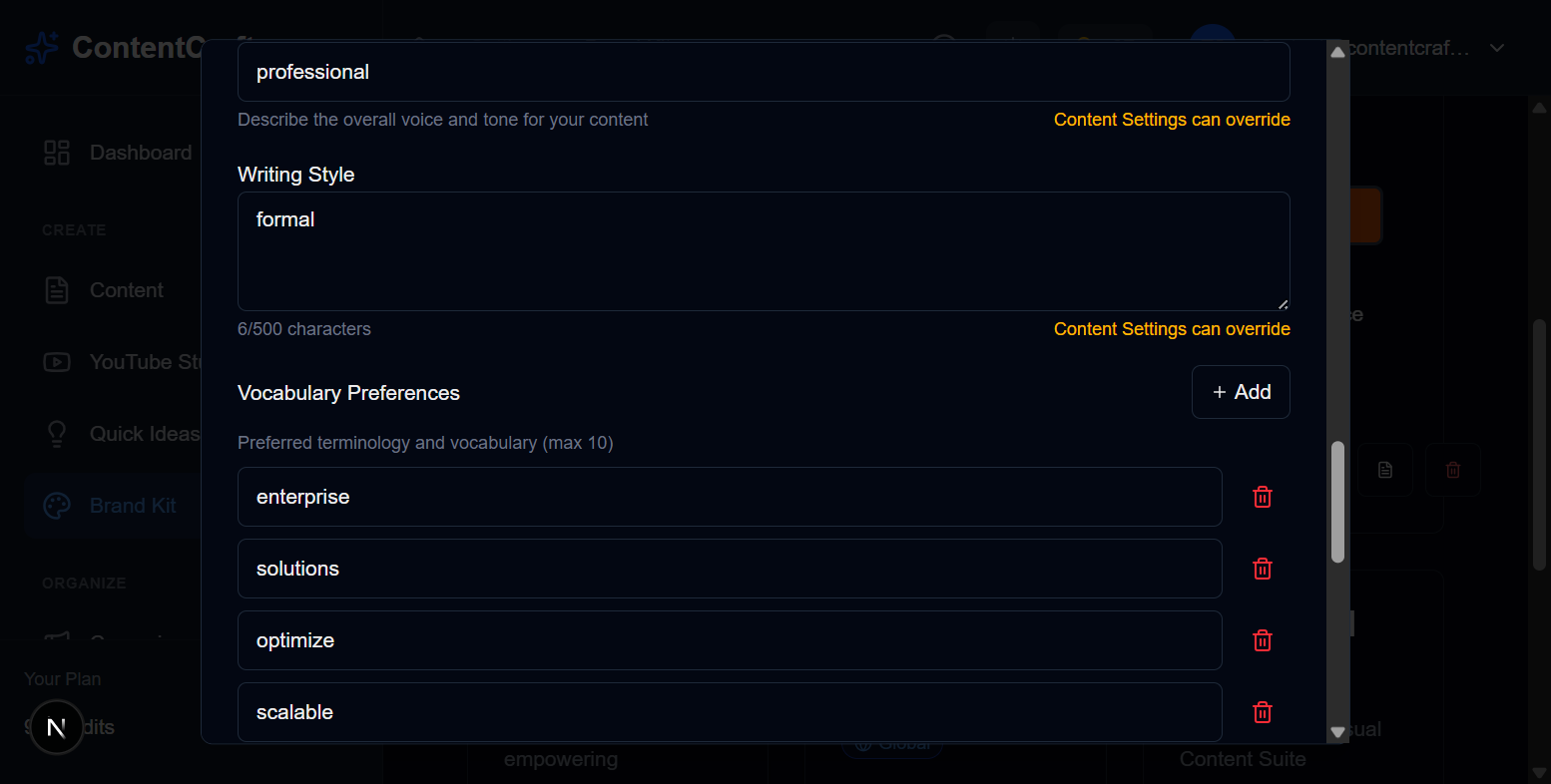
| Vocabulary preferences | Specific word choices with examples |
| Do's | Active guidance (10-15 items) |
| Don'ts | Things to avoid (10-15 items) |
| Structure notes | Sentence, paragraph, opening patterns |
| Sample library | 3-5 pieces to reference |
Strategic Recommendations:
Three to seven gaps worth filling. Topics to prioritize. Formats to experiment with. Audiences to target. Quick wins—content to repurpose, pieces to update.
Presenting the Audit
Do not simply deliver a document. Present your findings in a 20-30 minute call.
The presentation serves several purposes. It demonstrates strategic value—the client sees you thinking at a level beyond execution. It builds alignment before writing starts. It earns trust—you now know their content better than they do. It justifies premium rates by showing the strategic thinking behind your work.
Structure the presentation:
Voice Summary: "Based on analyzing [number] pieces, here's what I've learned about how you communicate. Your vocabulary emphasizes [patterns]. Your structure tends toward [patterns]. You consistently take positions on [topics]. You never [avoidances]."
Strategic Observations: "I noticed your content focuses heavily on [topic A] but rarely addresses [topic B]. Given your goals around [objective], there may be an opportunity here."
Recommendations: "For the next quarter, I'd suggest we prioritize [specific recommendations]."
Alignment Questions: "Before I begin writing, I want to confirm a few things about voice and direction."
Audit Shortcuts for Constrained Engagements
Full audits aren't always feasible. For smaller projects or tight timelines, these abbreviated approaches provide a working foundation.
The 20-Piece Audit (2-3 hours):
Read their 20 most recent pieces. Document 10 vocabulary patterns, 5 structural observations, 3 opinion positions. Produces enough material to write with reasonable confidence.
The Conversation Audit:
When minimal existing content exists, use the voice interview as your audit. Record the conversation. Note vocabulary and phrases they use naturally. Identify opinions they express. Build voice documentation from fresh data rather than archived content.
The Competitor Audit:
When the client lacks substantial content, audit their competitors instead. What are competitors saying? Where are the gaps? What can your client say differently? Position the client against the market.
Red Flags Worth Surfacing
Audits sometimes reveal problems that should be addressed before writing begins.
Significant voice inconsistency: If content from the same person sounds like five different authors, there's no established voice to capture. Surface this directly: "I noticed significant voice variation across your content. I recommend establishing a voice standard before we create new material—here's what I'd propose."
Strategic confusion: If content pulls in multiple directions without coherent themes, there's no underlying strategy. Raise it: "The content covers many topics without a clear focus. Can we align on three to five core themes before I start writing?"
Quality variance: If existing content varies dramatically in quality, you may be walking into unrealistic expectations or insufficient review processes. Ask: "I want to understand your review process. How was previous content developed?"
Multiple previous ghostwriters without systems: If voice shifts dramatically across the archive, they've likely worked with multiple ghostwriters without establishing persistent voice documentation. Offer to fix this: "I notice different voices in the archive. Let me establish a voice standard that can persist across contributors."
Time Investment and Return
| Audit Type | Time Investment | Revision Cycles Saved | Strategic Value Added |
|---|---|---|---|
| Basic (20 pieces) | 2-4 hours | 2-3 cycles | Moderate |
| Standard (50 pieces) | 6-8 hours | 4-5 cycles | Substantial |
| Comprehensive (75+ pieces) | 10-14 hours | 5-6 cycles | High |
The math works decisively in favor of auditing. A comprehensive audit of 12 hours prevents 20+ hours of revision cycles and establishes you as a strategic partner capable of commanding premium rates. The audit pays for itself within the first month of any substantial engagement.
The clients who value thorough auditing are the clients worth having. They understand that voice capture and strategic alignment require investment. They're willing to pay for the work that happens before writing begins. They stay longer, pay better, and refer more frequently.
The clients who push back on auditing—"just start writing, we'll figure it out"—are telling you something about how they'll treat the entire engagement. Listen to that signal.
Writesy AI supports systematic voice capture and content planning with brand kits designed for ghostwriter workflows. See how it works →
Further Reading
- Ghostwriting in the AI Era: What Changes and What Doesn't
- How to Decide What Content to Create (Without Guessing)
- How to Audit Your Content Strategy (Without Expensive Tools)
Free tools to try
Free Readability Checker
Check your content readability with marketing-specific benchmarks. Get a Flesch-Kincaid grade, color-coded sentences, and improvement tips.
Free Content ROI Calculator
Calculate your content marketing ROI. See cost per lead, payback period, and how content compares to paid ads. Free calculator.